
Surface Areas in Technoscience (Part 1)
Time is a generative substrate that determines the shape of the possible.

Scientific and technological progress is the source of most of the comforts of modern life: sanitation, electricity, antibiotics, flight, digital media. If we believe the leading technologists of the day,1 much more is coming. When we picture that next wave, our instinct is to want it fast: a cure for cancer would be better today than tomorrow. This need for speed pushes our innovation systems to produce as much, as quickly, as they can.
But the affordances that enable speed—more capital, more labor, more compute—are not only an accelerator. They are also a filter. When timelines compress, even if only in our minds,2 we do not simply get the same discoveries sooner. Compression changes which kinds of work get pursued at all.
True, endeavors that optimize, refine, scale, or execute against a clear, achievable objective often benefit from compressed timelines. But work that is truly exploratory by nature usually does not. Why that is so is the subject of this three-part series. We begin with time, and with a claim that sounds strange at first: time only looks like a line in hindsight. When viewed looking forward, it is instead a surface.
The Hidden Shape of Time
We tend to picture time as a straight line, running far forward into the future and deeply back into the past. A week is seven days laid end to end. A month is thirty more of the same. A task with no hard deadline takes the same seven days whether we start it this week or next. Time, in this picture, lives in a single dimension, and one stretch is interchangeable with another of equal length.3
That picture is incomplete. It is how time appears retrospectively, but not prospectively. To wit: trace any successful technoscientific discovery from its end back to its beginning, and it resolves into a clean line: this experiment, then that correction, then the result, as though events could only have run one way. But that is not how time looks as the work unfolds. Looking forward, every moment opens onto several possible next moves, and each of those onto several more. The future branches rather than stretches, and what hindsight flattens into a line began as surface, providing space for a widening tree of paths not yet taken.4
Generative potential lives on that surface, and a system that sees only the line will structurally suppress that potential. Understanding why requires examining two features of time that technoscience today largely overlooks: surface area and recursive accumulation.
The Surface Area of Time
Start with the line. If a researcher has four years instead of two, the one-dimensional picture says they get twice as many steps, and so twice as many chances. Twice the time, twice the opportunity.
Now look forward instead of back. At each step the work can branch: a result suggests, say, three directions worth trying, and whichever one is taken suggests three more.
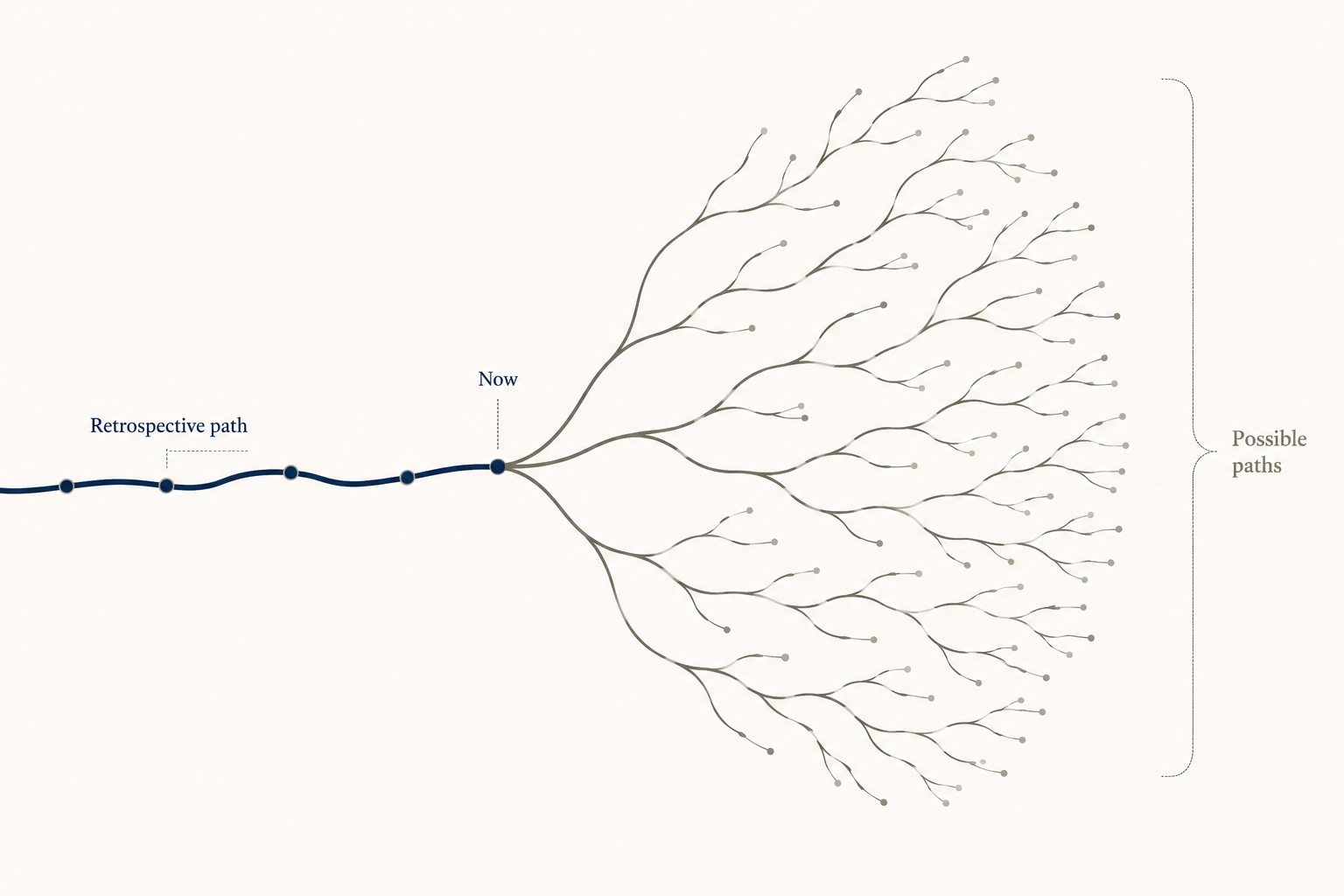
Count the distinct paths through that tree and the arithmetic is clearly not linear. Each step through time roughly triples the number of routes. Four steps open 27 possible paths; eight steps open 2,187. The timeline doubled. The possible paths, meanwhile, exploded more than eightyfold.5 This is what we mean when we say time has surface area: extend the line and you do not get a longer line, you get a wider surface.
When the goal is incremental (an optimization or a refinement), that explosion of paths is a burden rather than a gift. It becomes a problem of exhaustive search, the kind Edison faced in his light-bulb trials: thousands of materials tested over nearly two years until one worked. In that mode, a sensible aim is to shrink the possibility space and avoid wasted attempts. But when the goal is radical discovery, more paths mean more room for the unexpected. The surface area is the point.6
Why does that room matter so much? Because of variance. The trouble with a short timeline is not mainly that it creates stress. It is that it shrinks the space in which variance can appear, and variance is where many of the most important discoveries come from. Fleming’s penicillin is the textbook case: a contaminated culture during the course of extended research turned an accident into a breakthrough. Bell Labs shows the same pattern in technology: the transistor, which made modern electronics possible, did not come from executing against a known target. It came from noticing anomalous behavior that no one had set out to find. More time means more of the tree explored: more anomalies noticed, more dead ends repurposed, more chance encounters, more recombination, more opportunities for a project to end somewhere other than where it began. Long-duration searches don’t guarantee anything, but they widen the space in which variance can surface.
Recursive Accumulation
This affordance of space is even more powerful than the math above suggests, because the prospective surface also fundamentally changes as you move across it. That is the second property, and it is why a researcher cannot simply explore the whole tree at once, even with unlimited resources. Edison could test many filaments in parallel, because each trial stood on its own. But early astronomers staring at blurry images could not know they had to “correct for atmospheric distortion” until they had first discovered that the atmosphere was the problem. Each step they took reshaped and expanded the future paths available.
In short, the branches ahead (i.e., the possibility space) depend on the path already taken. What is known, and what sits just within reach of the known, determine what can be attempted now, and that boundary moves as the work proceeds.
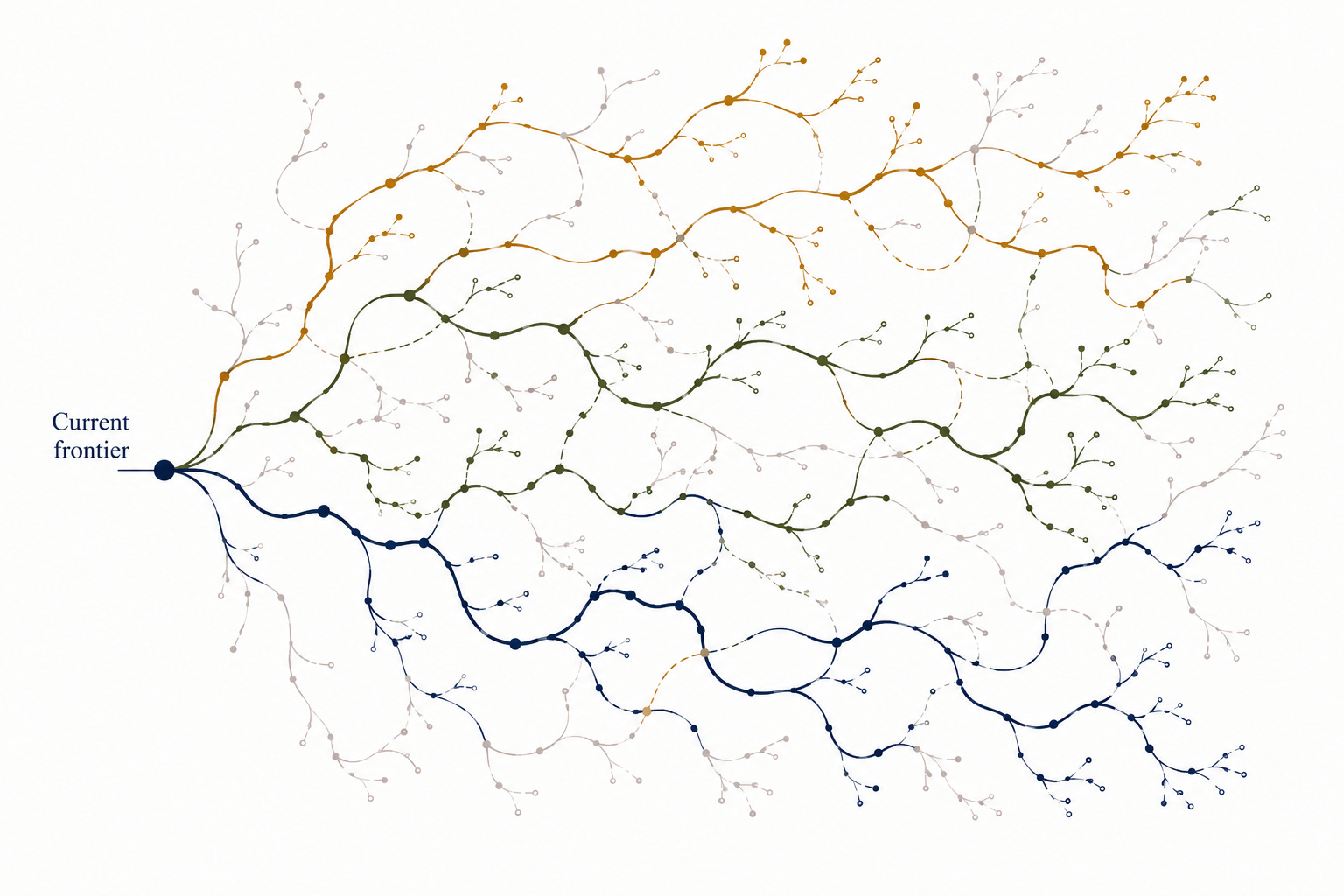
Take a different turn early and a different subtree opens: branches that were unreachable before become accessible, while other paths that once seemed open disappear entirely. The route already traveled does not just record where you have been. It defines where you can still go. Collapse the path back to its starting point, as a short timeline effectively does, and you do not get the same tree faster. You get a smaller tree.
Taken together, these two properties explain why compressing a timeline does not merely make discovery more stressful; it also shrinks the possibility space entirely.
Institutional Pressure
The problem is that our discovery institutions lean away from these properties rather than into them. Modern science and technology are built to compress time, to deliver the speed we ask for. Grant cycles, publication pressure, funding rounds, venture fund lifespans—these forces write that demand directly into the protocols of frontier work. The result: institutions are optimized to find the shortest path from a known start to an acceptable outcome, not the long, wandering path to the best one. These institutions are not choosing bad work. They’re solving a very particular problem—minimizing the distance to a result rather than maximizing the value of the result achieved.
Part of the mistake is a belief that high-variance work is just bad work with long odds—a waste of resources. Institutions, and the people they answer to, tell themselves they are open to tinkering and adventure. But waste is the one thing no one tolerates, and that distaste tends to win. The more a system demands milestones, forecasts, and near-term proof, the more it favors work whose path is already partly known. That is understandable. It also works against exactly the projects whose value emerges only through the doing.
High-variance work is work whose payoff is hard to see at the outset. It needs long horizons the way a plant needs water, light, and time. Consider Watson and Crick’s search for the structure of DNA. A fuller account is available here (it is worth reading), but serendipity and recursive accumulation showed up at least five times:
Watson only encountered the DNA problem because he attended a Naples conference outside his immediate research focus. Herman Kalckar invited him despite the fact that Watson was not meaningfully working with him.
Watson only heard Maurice Wilkins speak because J. T. Randall was too busy to give the scheduled talk and sent Wilkins instead. Wilkins’s talk got Watson interested in DNA and convinced him that X-ray crystallography might be the way to solve it.
Watson only made it to Cambridge because a few professors helped him work around the official purpose of his fellowship. He was supposed to be doing one kind of research, but he wanted to do something else. The system bent just enough to let him go.
At Cambridge, Watson happened to meet Francis Crick, whose strengths fit nicely with Watson’s weaknesses, and vice versa. Watson knew the biological stakes of the DNA problem; Crick understood the structural and chemical side far better.
Jerry Donohue happened to share an office with Watson and Crick at exactly the right time. Watson was relying on textbook diagrams that showed the wrong chemical forms of the DNA bases. Donohue knew they were probably wrong, told Watson so, and that correction opened the path to the right base-pairing structure.
None of these moments could have been scheduled. Watson couldn’t have known he needed to attend that Naples conference, or that Wilkins would be the one to speak, or that Donohue would be in the right office at the right time with the right expertise. Each branch opened only because the previous one had been taken, and each took time to traverse. Remove any one of them—compress the timeline, foreclose a path—and the double helix might have remained hidden for years longer.
This is what temporal surface area looks like in practice: not a predictable sequence of steps, but an accumulation of contingencies that only becomes legible in retrospect. Many of our exploratory institutions work well enough, perhaps “better than we deserve,” as Vannevar Bush might have said. But the irony is that we build our discovery institutions as if the retrospective view is the only one that matters. New institutions7 are needed.
Designing for Exploration
Many people say science needs more funding, especially after recent cuts, actual and threatened, in the United States. We agree, but we think it is only half the answer. Some science also needs protected duration, enough surface area for the unexpected to emerge. No amount of short-term funding can widen a search space that short timelines structurally constrain.
What would institutions built for that look like? A few principles come to mind:
First, they must not pre-destine the search, explicitly or implicitly. A search can be fixed in advance in two ways: in time and in direction. To pre-destine it in time is to prune the tree before the work really gets going. The obvious case is simple: an exploratory-first institution cannot cap its headline support at the usual two- or three-year term. But this limitation can also show up in subtler ways. Picture a researcher granted a ten-year, exploration-focused award by a foundation that is known to reorient its strategy every three years and that reserves the right to cancel annual payments at will. The researcher will plan for three years, not ten, and shape the work accordingly. (Direction can be pre-destined too, but we save that for a later essay).
Second, these institutions must let variance actually be explored. Explorers have to be free to follow their own sense of what is interesting as the work unfolds. That freedom requires concrete affordances: discretionary funds to pursue unexpected leads without re-justifying the budget, permission to pivot without triggering review processes, and protection from having to demonstrate progress against the original proposal. Without such mechanisms, giving researchers more time is like showing them a wider landscape but forbidding them from leaving the road. The surface area exists, but they cannot reach it.
Third, these institutions must provide explorers with ready access to expertise across domains. Real exploration naturally weaves in and out of disciplines as it unfolds. When work touches chemistry, then biology, then computational modeling, the explorer should be able to consult with chemists, biologists, and modelers without friction. Too often, though, institutions inadvertently steer searches back toward the competencies already housed within their walls, cutting off high-potential paths that require outside expertise. A well-designed exploratory institution actively connects its explorers to the right experts when the work demands it, rather than constraining the search to domains it already knows how to evaluate and support.
Finally, they must not be homogenous. There should be institutions of different temporal approaches, each using its own taste and judgment about which explorers will flourish within its environment. A healthy system does not put every project on the same clock. Some work should sprint. Some should compound over medium horizons. Some should be left to wander, because wandering is sometimes how breakthroughs begin.
Portfolio Approaches
As the last point suggests, we don’t believe every exploration should run on a long clock. Rather, the ecosystem as a whole should have a home for each kind. Individual institutions should be careful not to spread themselves across too many temporal styles at once;8 in aggregate, though, the range should be wide. Sizing that portfolio well is hard, and it will take experimentation, much of which will play out over generations. For orientation, it helps to note roughly how today’s allocations break down:
About 9% of venture capital goes to pre-seed and seed-stage investments, the earliest and most speculative category.9
About 10% of large technology companies’ revenue gets allocated to R&D.10
About 25% of federal science support goes to basic or fundamental research.11
These figures are not strictly comparable, and as we have noted, only a fraction of each is genuinely coded for a long horizon. Still, they give a rough sense of where a balanced portfolio might land.
Venture capital differs from science funding in one useful respect: the sheer breadth of its allocators. That diversity lives on a higher layer of the system (see the innovation-layers post here). A healthy ecosystem needs many allocators with different theses, different diligence standards, and different ways of choosing across timescales, not only within them.
And while some fields lend themselves to long horizons more than others, there is important long-horizon work across all of them. Mathematics rightly receives substantial long-horizon support. Biology needs it too, but gets far less. This disparity doesn’t track any fundamental difference in how discovery works—variance needs time to surface in both domains. It reflects institutional bias about which kinds of exploratory work are treated as legitimate. A well-functioning ecosystem has to set aside room for explorers in any and all domains to pursue long-duration, high-variance work, and back the conditions under which surprise can survive.
Choosing Which Futures to Explore
The idea of temporal surface area points to something uncomfortable: we cannot simply accelerate our way to breakthroughs. Compression reshapes which futures are reachable at all. Time, in other words, is not just a constraint to be beaten. It is a generative substrate that determines the shape of the possible. The paths that open over five years are not slower versions of the one-year paths. They are different paths, with different anomalies and different accumulations along the way.
We rarely get to choose how fast technoscience moves. When we act as if we do, by pulling the levers nearest to hand—tighter milestones, a fixation on legible deliverables—we unintentionally shrink the set of futures we can reach. Today’s innovation ecosystem optimizes far more for efficiency than for discovery, favoring discoveries that arrive through quick and direct paths over those that require extended exploration. It is no surprise, then, that the technological leaps of the last forty years feel smaller, in their remaking of daily life, than those of the forty years before, when discovery had more room to use time, variance, and recursive accumulation.
Asking any single institution, let alone the whole ecosystem, to abandon accountability, milestones, timelines, and discipline would be both unrealistic and irresponsible. The evidence, though, is hard to ignore: when the full range of affordances for discovery collapses into one standard form, everyone loses. The point is not that technoscience should be slow, or that short timelines are always wrong. It is that temporal surface area is its own dimension of innovation infrastructure, yet it has been structurally suppressed. We have collectively optimized our systems for speed and efficiency while ignoring the geometry of the search space itself.
Time is not the only surface area that matters. In Part 2, we turn to boundaries: how walls both constrain and enable discovery. In Part 3, we look at goal setting, and how the way we set targets shapes what we can find. Together, these surface areas form a way of understanding why our innovation system produces the results it does, and how it might be redesigned to produce a broader array of discoveries.
For too long the conversation has focused on money and risk.12 Far too little attention has gone to the structures beneath them—the affordances, as we call them—that make different kinds of exploration, and therefore different kinds of discovery, possible. That is the low-hanging fruit, and it is ready to pick.
See, for example, Dario Amodei, “Machines of Loving Grace,” (2024); and Sam Altman, “The Intelligence Age,” (2024).
Many projects run longer than planned, ending up far longer than intended. Even so, we argue that setting the shorter timeline at the outset has the effect described here, regardless of the actual duration. Roger Buehler, Dale Griffin, and Michael Ross, “Exploring the ‘Planning Fallacy’: Why People Underestimate Their Task Completion Times,” Journal of Personality and Social Psychology 67, no. 3 (1994); Daniel Kahneman and Amos Tversky, “Intuitive Prediction: Biases and Corrective Procedures,” in Judgment under Uncertainty: Heuristics and Biases, ed. Daniel Kahneman, Paul Slovic, and Amos Tversky (Cambridge: Cambridge University Press, 1982).
These two assumptions—the linearity of time and the fungibility of time—are the two most common misconceptions about the nature of time in discovery work.
While we are primarily arguing that this is metaphysically true, there are arguments that it is also physically true, in the form of the various multiverse theories, some of which posit that ‘paths not taken’ actually unfold in a currently unperceivable dimension. For those interested in this line of thinking, The Hidden Reality by Brian Greene is an approachable place to start. Brian Greene, The Hidden Reality: Parallel Universes and the Deep Laws of the Cosmos (New York: Alfred A. Knopf, 2011).
This calculation assumes three branches at each decision point, as described above. The actual branching factor varies by field and project, but the exponential pattern holds regardless: even modest branching (say, 2x per step) produces dramatic expansion of the possibility space over time.
For more background in how our concept of surface area inculcates generativity, see:
March, James G. “Exploration and Exploitation in Organizational Learning.” Organization Science 2, no. 1 (1991); Lu Hong and Scott E. Page, “Groups of Diverse Problem Solvers Can Outperform Groups of High-Ability Problem Solvers,” Proceedings of the National Academy of Sciences 101, no. 46 (2004); Nassim Nicholas Taleb, Antifragile: Things That Gain from Disorder (New York: Random House, 2012).
While we speak of creating new institutions throughout, many of these principles could be implemented by restructuring existing organizations. Reform is sometimes more practical than creation, though institutional inertia can make real restructuring as hard as starting fresh.
The phrase “stick to your knitting” applies: one organization may not be able to excel across a wide spectrum of temporal approaches at once.
Gené Teare, “Global Venture Funding in 2025 Surged as Startup Deals Hit Third-Highest Year on Record,” Crunchbase News, January 7, 2026.
Microsoft Corporation, Form 10-K for the Fiscal Year Ended June 30, 2025. Microsoft reported $32.488 billion in research and development expenses and $281.724 billion in total revenue, implying R&D spending equal to approximately 11.5% of revenue.
Apple Inc., Form 10-K for the Fiscal Year Ended September 27, 2025. Apple reported $34.55 billion in research and development expenses and $416.161 billion in net sales, implying R&D spending equal to approximately 8.3% of net sales.
National Center for Science and Engineering Statistics, National Science Foundation, “Federal Funds for Research and Development: Fiscal Years 2024–25.”
Chiara Franzoni and Paula Stephan, "Uncertainty and Risk-Taking in Science: Meaning, Measurement and Management in Peer Review of Research Proposals," NBER Working Paper 28562 (2021).